
What in the World Is God Doing —and How Can I Join Him?
The Mission of God: Lesson One
By Steven L. Childers

Listen to the Audio
Want to go deeper? Take the Learning Path.
What is a Learning Path?
A Learning Path is a guided sequence of ten practical steps designed to move you beyond simply understanding biblical truth toward applying it to your mind, heart, and life with others. They include the full lecture transcript with academic footnotes, reflection and discussion questions, a prayer guide, an interactive quiz with answers, hymns for worship, recommended books, and more to help you go deeper.
You can use the Learning Path on your own for personal study—or, even better, invite a friend, spouse, mentor, or small group to walk through the ten steps with you. Better still, consider leading the group yourself. You don't need to be a trained teacher; you simply need to be one step ahead, guiding others through what you've already begun to learn.
Why learn with others—and even more, why lead? Because truth deepens when shared, and nothing teaches us like teaching others. As Seneca said, "While we teach, we learn."
Read the Article (Presentation Notes)
Introduction: What in the World is God Doing?
Viktor Frankl, the Austrian psychiatrist and Holocaust survivor, argued that our deepest need is not pleasure, possessions, or power, but meaning.
Even in the concentration camps, he saw people endure unimaginable suffering when they had something—or someone—worth living for.
Yet we often live by smaller stories centered on comfort, success, security, or personal fulfillment—good gifts that cannot bear the weight of our deepest hopes.
Jesus calls us into an upside-down kingdom in which we find life by no longer making ourselves its center. "Whoever loses his life for my sake and the gospel's will save it" (Mark 8:35).
When our smaller stories align with God’s greater story, the path may include sacrifice and loss—yet in surrendering to Christ and his mission, we discover a life no suffering can destroy.
You were created by God in his image. And if you're a follower of Christ, God is now recreating you by his Spirit for purposes far greater than yourself. Paul writes, “We are his workmanship, created in Christ Jesus for good works” (Eph. 2:10).
This raises the central question of this course: What in the world is God doing—and how can I join him?
During these six lessons, we will learn what God is doing in the world and how our lives can align with his purposes.
We'll learn from Scripture that God delights to manifest his presence and pour out his power on those who will dare to align their purposes more with his purposes for the world.
In this first lesson, we will see how the whole Bible reveals God’s grand story, how it unfolds through his magnificent acts, and how it can reshape our own.
I. The Whole Bible Reveals the Grand Story of God's Mission
A. The Bible reveals one grand story of God's mission.
We begin not with a few New Testament mission passages, but with the whole Bible. Though written by many human authors over generations, the Bible is one divinely inspired book with one divine Author, telling one unified story of God’s mission.[1]
This is why we must resist fragmenting the Bible into isolated stories, doctrines, and moral lessons.[2] As Edmund Clowney observed, we can know Bible doctrine and many Bible stories, but still miss the Bible Story.[3]
The Bible opens with a world without sin in Genesis 1–2 and closes with one restored in Revelation 21–22. Between those bookends unfolds the triune God’s mission to redeem and restore what humanity’s fall ruined.
Jesus taught us to read Scripture this way. After his resurrection, he showed his disciples how the Old Testament pointed to him and to God's mission through him to proclaim repentance and forgiveness in his name to all nations (Luke 24:27, 45–47).[4]
God’s mission, then, is not merely one biblical theme among many, but a central thread woven through the whole Bible. We need more than a biblical basis for missions; we need to read the whole Bible missionally—as the unfolding story of what God is doing in history.
B. This grand story reveals the true story of the whole world.
The Bible’s grand story does more than unite Scripture. It explains reality.
Everyone lives within a story that answers life’s deepest questions: Where did we come from? Why is the world broken? What will make things right? Where is history going? Where do we fit?
Many rival stories try to explain reality through human progress, political liberation, economic prosperity, personal fulfillment, scientific materialism, and more.
The Bible tells us that we were created by God, for God, and in his image; that humanity and creation were ruined by sin; and that God is redeeming and restoring his people and world through his Son and by his Spirit until Christ makes all things new
This story explains both the beauty and brokenness of the world, and both the dignity and depravity of humanity. It is not merely one religious story among many, but the true story of the whole world.[5]
Lesslie Newbigin told of a Hindu leader who urged missionaries not to present the Bible merely as another “book of religion.” What made it unique, he said, was that it interpreted universal history—the story of creation, humanity, and every person’s place within it.[6]
C. This Grand Story Draws Us In
And this is where the story becomes personal.
The Bible is not merely a religious story to understand. It is the true story of the world in which God calls you to find your identity, purpose, and place.[7] We cannot fully understand ourselves or find lasting fulfillment apart from the God who created us and the purposes for which he made us.[8]
Deep and lasting joy comes as we embrace what Tim Keller calls “the freedom of self-forgetfulness” and align our smaller story with God’s greater story—our purpose with his purpose, and our mission with his.[9]
II. The Grand Story Reveals the Magnificent Acts of God in Mission
The Bible’s grand story unfolds through a series of magnificent acts in which the triune God carries forward his mission for humanity and the world. Although the Father, Son, and Spirit always work inseparably, Scripture gives special prominence to the Father in creation, the Son in redemption, and the Spirit in restoration.
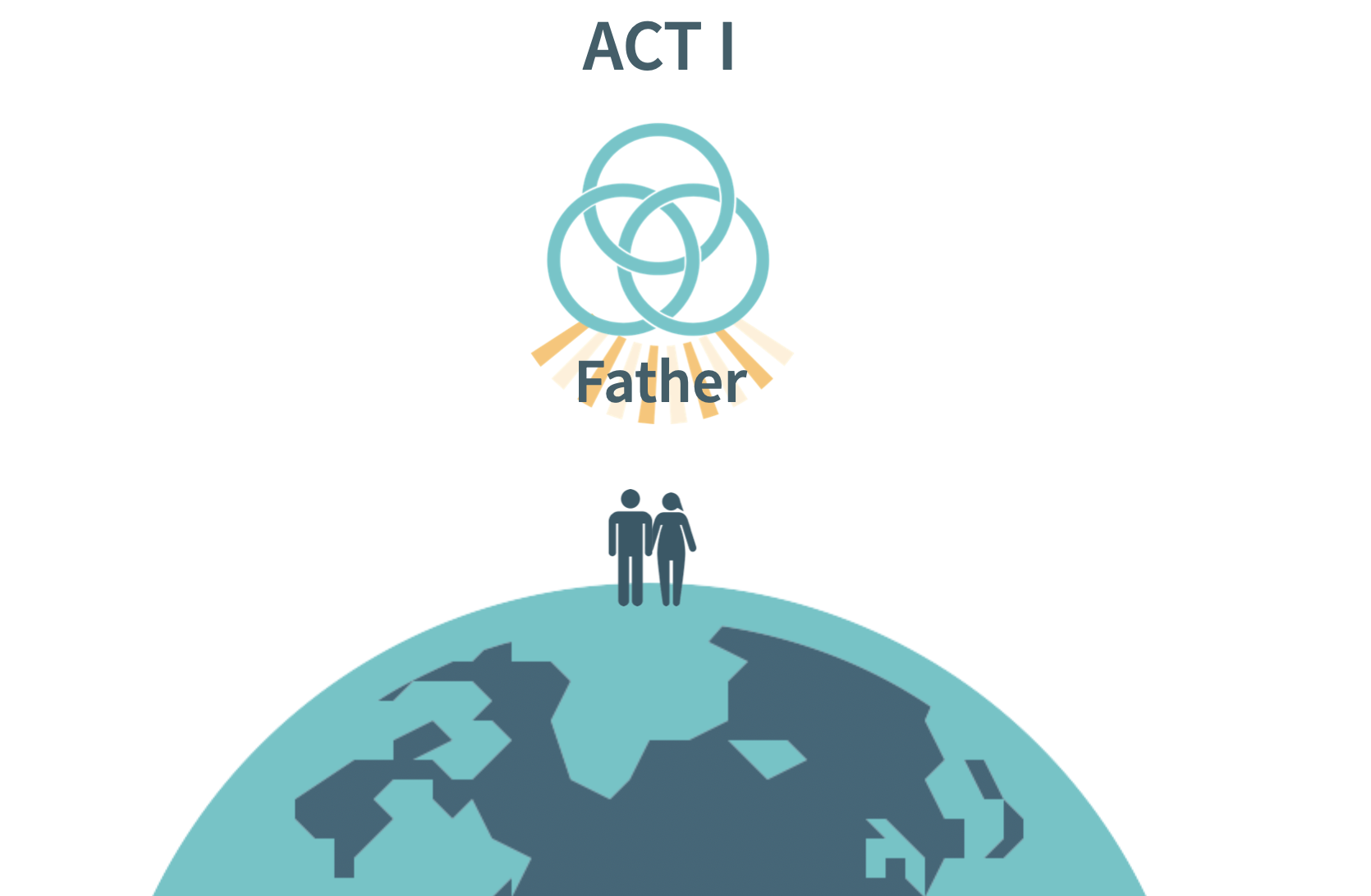
Act One: The Magnificent Acts of the Father in Creation
Many assume God’s mission begins with Jesus' Great Commission in Matthew 28. It doesn’t. God’s first commission comes in Genesis 1–2—before the Fall, Israel, or Christ.
And here is what surprises many: when God finished creating humanity and the world, both were good, but neither was complete. Humanity had not reached full maturity, and creation had also not reached its full potential under humanity’s influence.
This incompleteness was not a flaw in humanity or creation — it was why God gave humanity his mission for them and the world. As his image-bearing representatives, they were to “be fruitful and multiply and fill the earth and subdue it” (Gen. 1:28).
God called them to enjoy his presence, reflect his character, represent his gracious rule, and extend his blessing throughout creation. In other words, God’s original mission was to glorify his name by causing his kingdom to come throughout his creation through his people by the power of his Spirit.
In Lesson two we'll see how this original mission still defines our calling and mission today. God has sovereignly placed you within particular relationships, vocations, communities, and spheres of influence where you are called to make his invisible kingdom increasingly visible.
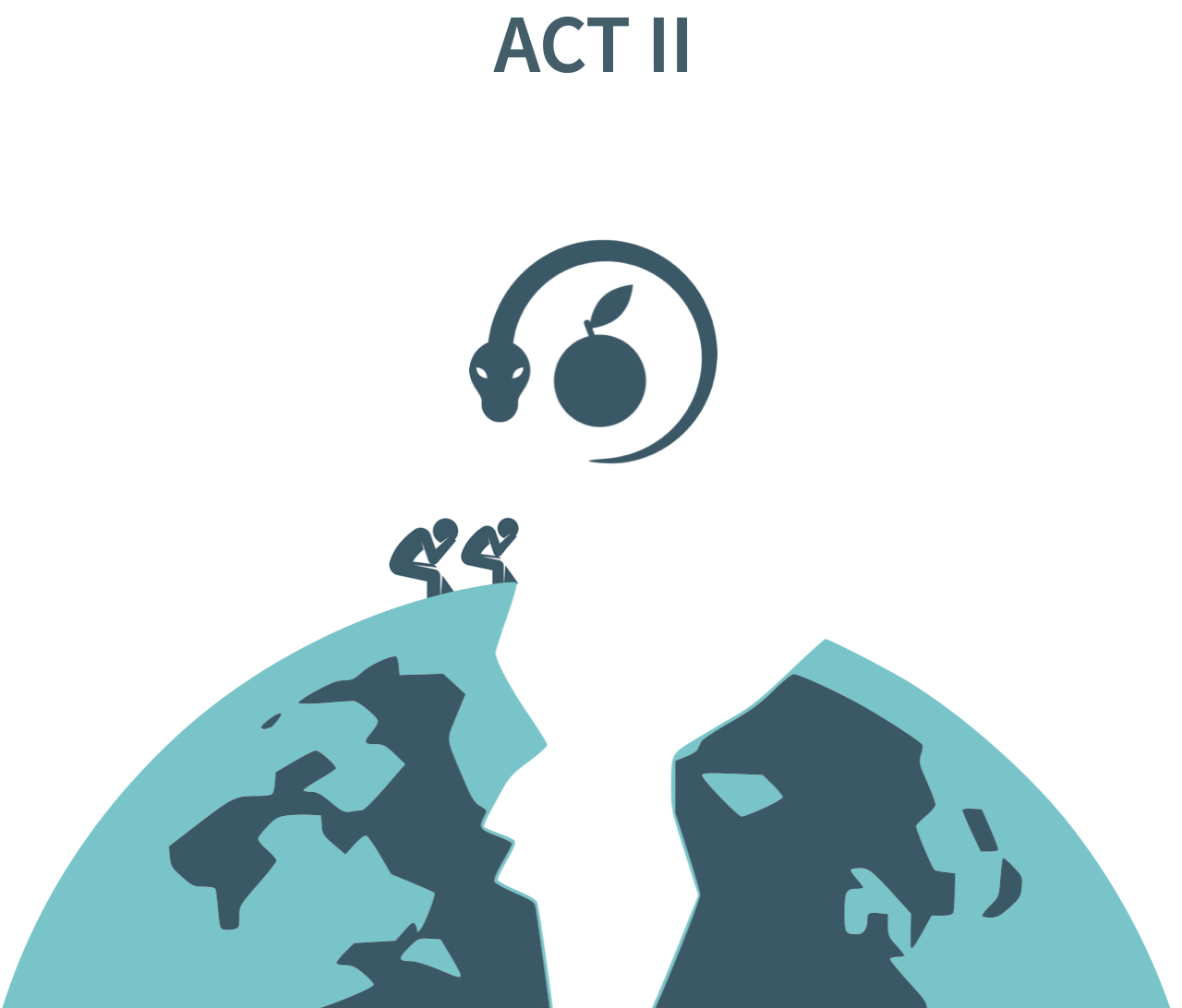
Act Two: The Rebellious Acts of Humanity in the Fall
The second act opens with catastrophe, as Satan enters the drama to overthrow God's mission by tempting Adam and Eve to reject his lordship. And the effects are far greater than many realize.
The Fall did not merely break our relationship with God; it corrupted humanity, disordered the world, and radically distorted humanity’s role in God’s mission.
The depth of our understanding of the Fall directly shapes the depth of our understanding and experience of God’s salvation—and therefore of God’s mission. Martin Luther captured the principle memorably: “If you see yourself as a little sinner, then you will see Jesus as a little Savior.”
In Lesson 3, we will see that humanity’s rebellion left us with a double problem: we lost our innocent standing and the purity of our hearts. Innocence became guilt, and pure hearts became corrupt and idolatrous hearts. This is why the old hymn, "Rock of Ages" speaks of how our sin needs a “double cure”—cleansing us from both its guilt and its power over our hearts.
But the Fall reached even further. Humanity was not the only thing corrupted. God’s good world was subjected to frustration, suffering, death, and the tyrannical rule of Satan—the one Jesus calls “the ruler of this world.”
Instead of using their God-given influence to extend his gracious rule, fallen humanity began building rival kingdoms for its own glory. Yet God’s mission was thwarted, not abandoned. What he chooses to do next is nothing less than astonishing grace.
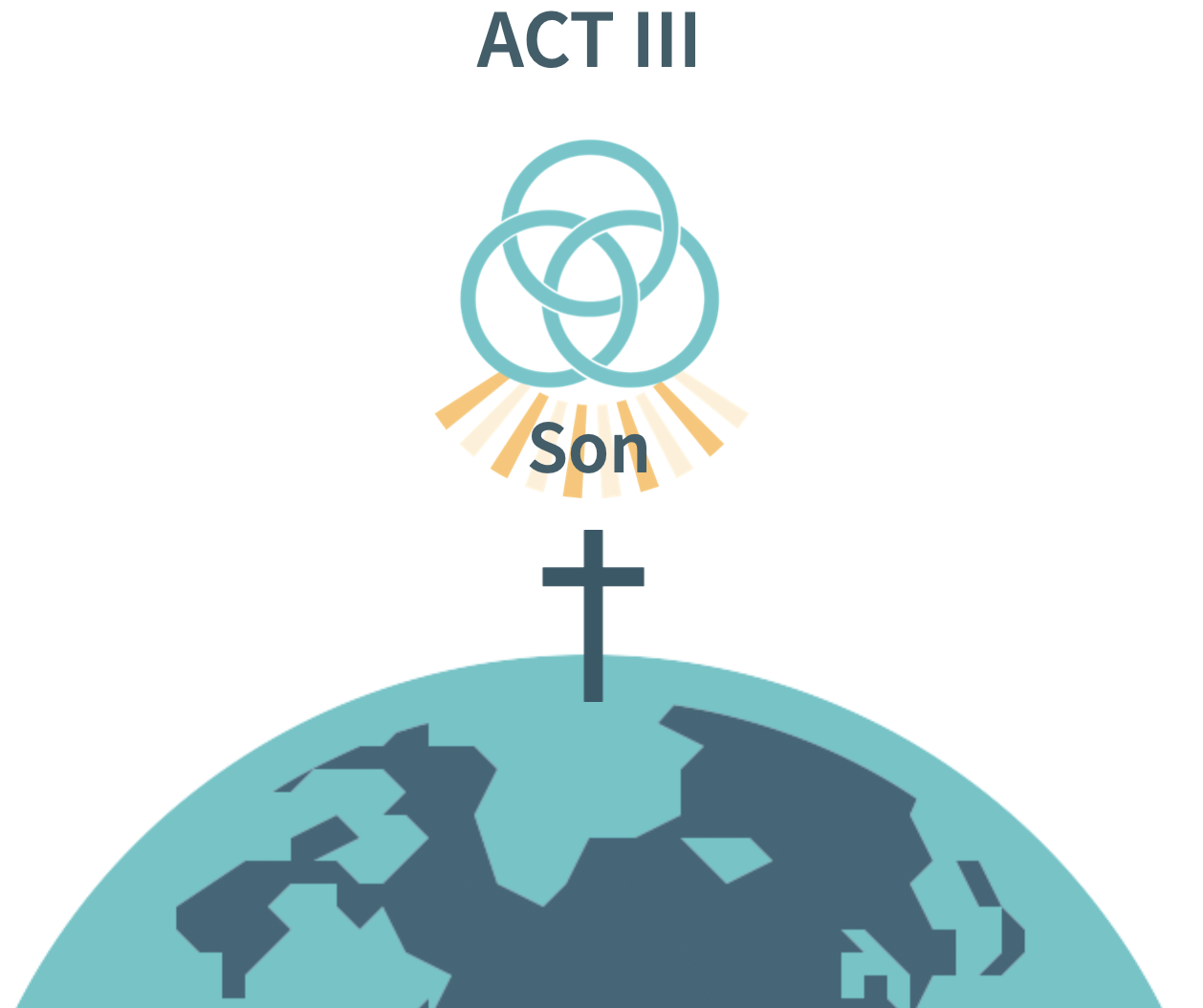
Act Three: The Magnificent Acts of the Son in Redemption
The third act opens with astonishing grace. Even in judgment, he promises a Redeemer who will defeat the serpent and rescue his fallen people and world (Gen. 3:15).
In Lesson 4, we'll discover that the Son’s redemptive work is far greater than many realize. Long before his incarnation, the eternal Son was at work redeeming Israel through God’s covenants and promises, all pointing toward a Redeemer King still to come.[10]
Then, in the fullness of time, that redemptive work reaches its climax as the eternal Son takes on humanity and extends salvation to every nation.
The cross stands at the center of the Son's magnificent acts as Redeemer, but it does not stand alone. His incarnation and birth, perfect life, sacrificial death, resurrection, and ascension reveal not only what Jesus did, but who he is—Savior and Lord.
But humanity is not the only captive needing rescue. The world itself lies under Satan’s tyrannical rule. At the cross, Jesus strikes the decisive blow against the powers of darkness: what appears to be Satan’s greatest victory becomes his greatest defeat as Christ triumphs over him Col. 2:15).[11]
His redemption is therefore not only personal but cosmic. Satan is defeated, but not destroyed. Death is conquered but not yet removed. The new creation has begun but has not yet filled the earth.[12]
This prepares the stage for the final act, in which the Holy Spirit applies the Son’s completed redemption and carries God’s mission toward its appointed fullness.
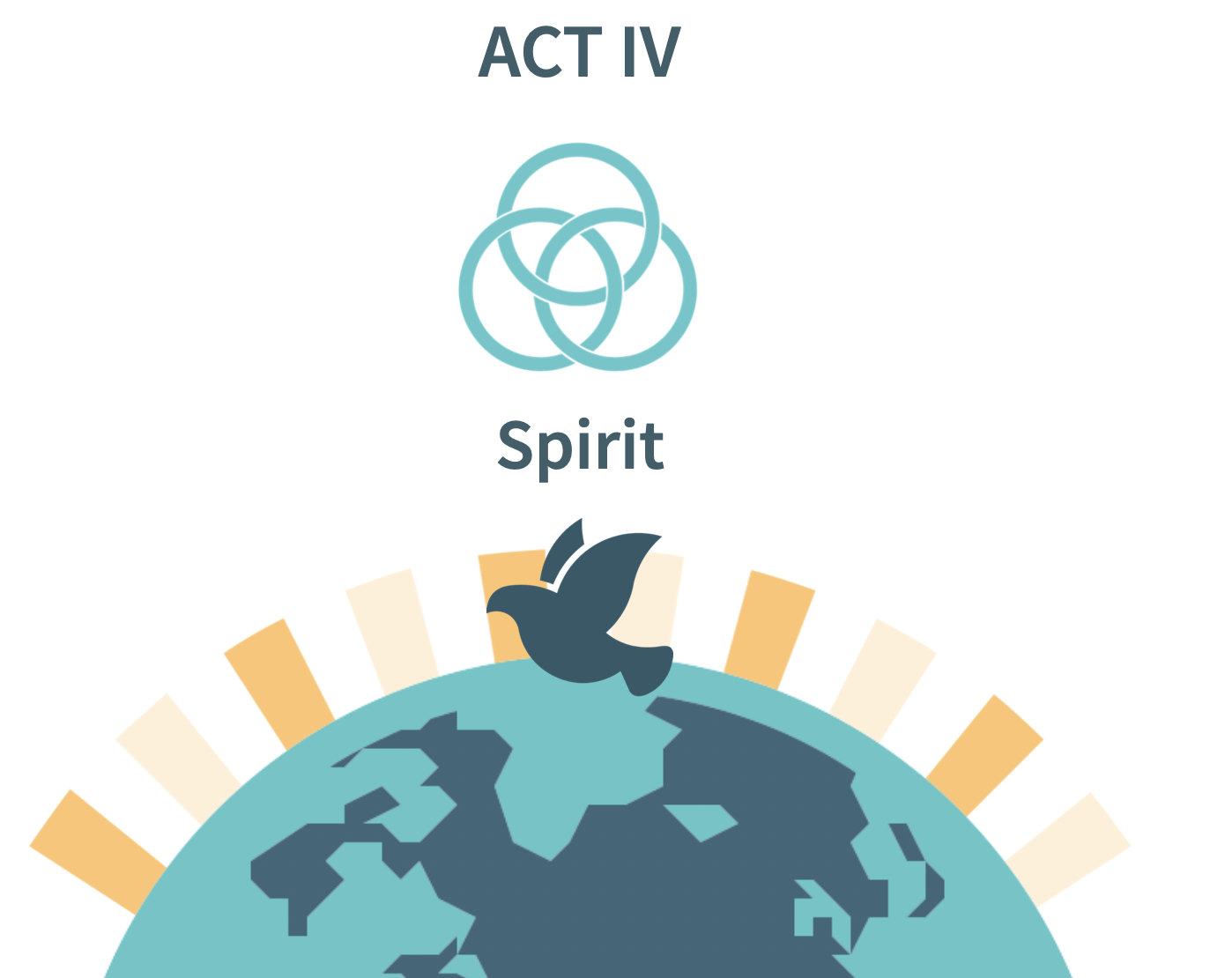
Act Four: The Magnificent Acts of the Spirit in Restoration
The final act begins at Pentecost, when the risen and ascended Christ pours out his promised Holy Spirit. The Son has accomplished redemption; now the Spirit applies that redemption, restores God’s people and world, and carries God’s mission toward its appointed fullness.
This act unfolds in two great scenes—and because both are so important, we will devote a full lesson to each.
Scene One: The Proclaimed Kingdom—Already
Lesson 5 will begin with a simple but important question: Where are we now in the unfolding drama of God’s mission? Pentecost gives us the answer. The risen Christ has been enthroned at the Father’s right hand and has poured out the Spirit upon his people. The age Scripture calls “the last days” has begun, and this is the part of the story in which we now live.
We will see how the Spirit applies the redemption accomplished by Christ by beginning to reverse the curse of the Fall. He gives God’s people a new standing before him through forgiveness and righteousness, a new heart through regeneration and indwelling, and the promise and
firstfruits of a new world.
In this way, the Spirit forms the church as the firstfruits of God’s new humanity, gathering people from every tribe, language, people, and nation into one body under one Lord.
But the Spirit does not merely gather God’s people out of the world—he sends them back into it. Through the church, the risen Christ continues his redemptive mission as his people obey the Great Commission by making disciples of all nations, calling others to repentance and faith, and restoring them to fellowship with God through Christ.
This redemptive mission also restores God’s people to their original creation mission. Redeemed by the Son and renewed by the Spirit, they are once again called to glorify God by reflecting his character, representing his gracious rule, and advancing his kingdom in every sphere of life.
Gathered for worship and scattered throughout daily life, God’s people enter their relationships, vocations, neighborhoods, and communities as salt and light—making Christ’s invisible kingdom increasingly visible through their witness, service, mercy, justice, and obedience.
This is the remarkable tension of the age in which we live: Christ reigns, the Spirit is at work, and the kingdom is truly present—yet not complete. Sin, suffering, injustice, and death remain.
In Lesson 5, we will see more clearly what it means to live faithfully in this “already, but not yet” kingdom—and how our lives fit into God’s mission today.
Scene Two: The Coming Kingdom—Not Yet
Lesson 6 takes us to the climactic final scene of the biblical drama: Christ’s return and the restoration of all things by the power of his Spirit. Many Christians assume our final destiny is to leave creation behind and spend eternity in heaven as disembodied spirits. But Scripture gives us a far greater hope.
When Christ returns, Satan, sin, and death will finally be defeated. The dead will be raised, God’s redeemed people will receive glorified bodies, and creation itself will be liberated
from its bondage to corruption.[13]
Our final destiny is not an escape from creation, but life with God in a renewed creation. Heaven and earth will be united. God will dwell with his people, suffering and death will be no more, and the One seated on the throne will declare, “Behold, I am making all things new” (Rev. 21:5).
And here we will discover another surprising truth: when God’s redemptive mission is completed, God’s original creation mission will not end. Instead, the mission introduced in Act One will finally be restored and fulfilled without opposition.
The new creation will be perfect, but like God’s original creation, it will not be static or exhausted.
Redeemed humanity will continue to grow in the knowledge and love of God, deepen in love for one another, develop our God-given capacities, and cultivate the renewed world entrusted to us. We will joyfully serve, create, discover, reign, and flourish under Christ’s lordship forever.
At last, humanity will fulfill God’s original mission without sin, Satan, or death opposing it: glorifying his name by making his invisible kingdom visible throughout creation through his people
by the power of his Spirit.
And this future is meant to reshape how we live now. Once we understand what God is preparing us to do forever in renewed bodies on a renewed earth, we are meant to connect the dots. The life of the coming kingdom is not merely something we wait for; it is something we begin to embody now.
By the Spirit, our lives today are meant to become a foretaste of the world to come. The mission we will fulfill forever is the mission we are called to begin living now.
III. How God’s Story Reshapes Our Stories
God’s magnificent acts are not merely events to understand. They reveal who the triune God is, what he is doing in the world, and how our lives can be transformed as we find our place within his unfolding story.
In the lessons ahead, we will view each act through three practical lenses, asking how God’s unfolding mission deepens our understanding and experience of three biblical realities: God’s gospel, God’s salvation, and God’s mission.
A. God’s Gospel
God’s unfolding mission deepens our understanding and experience of the gospel by showing us that it is far greater than many Christians realize. It is not only the good news of who Jesus is and what he has done, but also the good news of who the triune God is and what he is doing.
The cosmic good news is that the Father’s creation, ruined by humanity’s fall, has been redeemed by his Son and is being restored by his Spirit into the eternal kingdom of God on earth.
And this cosmic gospel is also deeply personal. It is the good news that the Father so loved the world that he sent his Son to redeem us and promises all who trust in him forgiveness of sins and the gift of his indwelling Spirit, who restores us to God and increasingly into the fullness of life and his original mission for which he created us.
B. God's Salvation
God’s unfolding mission also helps us deepen our understanding and experience of salvation by showing us that it is more than forgiveness or the promise of heaven after death—as glorious as those truths are. Salvation includes God’s work of restoring everything the Fall has broken.
Augustine described God as our “Creator and Re-Creator,” while Herman Bavinck summarized this biblical vision in the memorable words, “Grace restores nature.” God’s grace does not rescue us from creation, but from sin, so that humanity and creation may become what God always intended them to be.
C. God's Mission
Studying God’s unfolding mission in Scripture will also deepen your understanding and experience of mission by showing that it is far greater than making disciples alone—as central as the Great Commission is. God’s redemptive mission serves the larger purpose of restoring his people to the original mission he gave humanity at creation.
Jesus’ Great Commission tells the church what to do: make disciples of all nations. But the prayer Jesus taught us reveals the greater purpose behind that mission: that the Father’s name would be hallowed, his kingdom would come, and his will would be done on earth as it is in heaven.
So throughout the course, we will keep asking how each act of God in history deepens our understanding and experience of God's gospel, God's salvation, and God's mission—not merely so that we better understand God’s story, but so that we are drawn into it and find our place within it.
Conclusion: Serving God’s Purpose in Our Generation
This is where the purpose of this course becomes deeply personal, rooted in one central truth:
“God delights to manifest his presence and pour out his power on those who will dare to align their life mission with his mission for the world.”
Paul said of David that “after he had served the purpose of God in his own generation, [he] fell asleep” --meaning then he died (Acts 13:36). Like David, each of us has been given a brief span of life in which to serve God’s purposes.
Jesus gives us the greatest example. Near the end of his earthly life, he prayed, “I glorified you on earth, having accomplished the work that you gave me to do” (John 17:4). What greater hope could we have than to reach the end of our lives able to pray something similar?
When I was in my early twenties, an elderly pastor mentored me. I can still hear him saying, “Steve, never forget: Only one life will soon be past; only what’s done for Christ will last.”
You are not alive at this moment in history by chance. The God who created you is now recreating you in Christ so that you may find your place in his story, make his mission your mission, and serve his purposes in the time left he has entrusted to you.
So the question is not merely, “What in the world is God doing? The question is also, “Will you join him?”
FOOTNOTES
[1] The Bible is not a hodgepodge of disconnected stories, doctrines, and moral lessons that we must arrange into a coherent whole. Kevin Vanhoozer describes this traditional approach to theology when he writes, “For large swaths of the Western tradition, the task of theology consisted in mining propositional nuggets from the biblical deposit of truth. Kevin J. Vanhoozer, “Lost in Interpretation? Truth, Scripture, and Hermeneutics,” Journal of the Evangelical Theological Society 48, no. 1 (March 2005): 94.
[2] Michael Goheen warns: We have fragmented the Bible into bits … moral bits, systematic-theological bits, devotional bits, narrative bits, and sermon bits. And when the Bible is broken up in this way there is no comprehensive grand narrative to withstand the power of the comprehensive humanist narrative that shapes our culture. Michael W. Goheen, Reading the Bible Missionally (Eerdmans, 2016). See also Craig G. Bartholomew and Michael W. Goheen, The Drama of Scripture: Finding Our Place in the Biblical Story, 2nd ed. (Baker Academic, 2014).
[3] Edmund Clowney writes, "The Bible is much more than William How stated: ‘a golden casket where gems of truth are stored.’ It is more than a bewildering collection of oracles, proverbs, poems, architectural directions, annals, and prophecies. The Bible has a story line. It traces an unfolding drama .... The story is God’s story. It describes His work to rescue rebels from their folly, guilt, and ruin.... Only God’s revelation can build a story where the end is anticipated from the beginning, and where the guiding principle is not chance or fate, but a promise. Human authors may build fiction around a plot they have devised, but only God can shape history to a real and ultimate purpose." Edmund P. Clowney, The Unfolding Mystery: Discovering Christ in the Old Testament, 2nd ed. (P&R Publishing, 2013), 12–13.
[4] Jesus’ teaching in Luke 24 shows that the Old Testament must be read not only Christologically but also Missionally. See also John 5:39; Luke 24:27, 44–47.
[5] This is why Christian mission does not call people merely to adopt a new religion, as though faith belonged only to the sacred or private part of life. The gospel calls us to turn from every rival story and bring every sphere of life under the lordship of Christ. As Abraham Kuyper famously declared, “There is not a square inch in the whole domain of our human existence over which Christ, who is Sovereign over all, does not cry: ‘Mine!’” Herman Bavinck expresses the same comprehensive vision in his teaching that grace does not destroy nature but restores it. In other words, Christ’s redeeming work does not remove us from God’s created world, but restores us and the world according to God’s original design. See Abraham Kuyper, “Sphere Sovereignty,” in Abraham Kuyper: A Centennial Reader, ed. James D. Bratt (Grand Rapids: Eerdmans, 1998), 488; Herman Bavinck, Reformed Dogmatics, vol. 3, Sin and Salvation in Christ, ed. John Bolt, trans. John Vriend (Grand Rapids: Baker Academic, 2006), 577; Herman Bavinck, Reformed Dogmatics, vol. 4, Holy Spirit, Church, and New Creation, ed. John Bolt, trans. John Vriend (Grand Rapids: Baker Academic, 2008), 715–20.
[6] Lesslie Newbigin, A Walk Through the Bible (Regent College Publishing, 2005), 4. Newbigin tells the story of a Hindu leader in India who revealed their understanding of this when he challenged missionaries; “I can’t understand why you missionaries present the Bible to us in India as a book of religion. It is not a book of religion—and anyway we have plenty of books of religion in India. We don’t need any more! I find in your Bible a unique interpretation of universal history, the history of the whole of creation and the history of the human race. And therefore a unique interpretation of the human person as a responsible actor in history. That is unique. There is nothing else in the whole religious literature of the world to put alongside it.”
[7] This is why the biblical story continues to resonate across all cultures and generations. It is not a fairy tale, but it has given birth to thousands of fairy tales. All the themes found in humanity's greatest stories—a true king, a lost kingdom, a heroic deliverer, sacrificial love, exile and homecoming, death and resurrection, and a final happy ending—echo the deeper realities revealed in Scripture.
[8] Augustine captured this reality when he wrote, "You have made us for yourself, O Lord, and our hearts are restless until they rest in you." The French physicist Blaise Pascal similarly observed that every human heart contains a longing that only God can satisfy. John Piper has popularized Jonathan Edwards’s thesis that “God is most glorified in us when we are most satisfied in him.” At its core, this means learning to find your ultimate satisfaction and joy not only in who God is—his attributes—but also by participating in what God does: his magnificent acts and unfolding purpose for the world.” See Augustine, Confessions, trans. Henry Chadwick (Oxford: Oxford University Press, 1991), 3; Blaise Pascal, Pensées, trans. A. J. Krailsheimer (London: Penguin Books, 1995), 45; Jonathan Edwards, The End for Which God Created the World, in God’s Passion for His Glory, ed. John Piper (Wheaton, IL: Crossway, 1998); John Piper, Desiring God: Meditations of a Christian Hedonist, rev. ed. (Sisters, OR: Multnomah, 2003), 18.
[9] As C. S. Lewis writes, “Aim at Heaven and you will get earth ‘thrown in’: aim at earth and you will get neither.” See Augustine, Confessions, trans. Henry Chadwick (Oxford University Press, 1991), 3 (1.1.1). See Timothy Keller, The Freedom of Self-Forgetfulness: The Path to True Christian Joy (10Publishing, 2012); C. S. Lewis, Mere Christianity (HarperOne, 2001), bk. 3, chap. 10, “Hope.”
[10] Jesus taught that the Old Testament Scriptures revealed both himself and God’s unfolding mission. Jude even identifies Jesus as the one who delivered Israel from Egypt, while Paul writes that the spiritual Rock accompanying Israel was Christ (Jude 5; 1 Cor. 10:4).
[11] Like the White Witch in C. S. Lewis’s The Lion, the Witch and the Wardrobe, he mistakes sacrificial death for final victory. Yet Christ’s resurrection reveals a deeper triumph: death itself becomes the means through which the enemy’s power is broken.
[12] Like the Allied landing at Normandy in World War II, Christ’s victory has determined the outcome (D-Day) even though the battle continues. Satan is defeated but still active. Death is conquered but not yet removed. The new creation has begun but has not yet filled the earth. In the final act, we will see the parallel to VE-Day, when Christ’s decisive victory is brought to its final consummation.
[13] As Paul writes, creation now “waits with eager longing” and will one day be “set free from its bondage to corruption” to share in the freedom and glory of God’s children (Rom. 8:19, 21). The restoration of God’s people and the restoration of his world therefore belong together.

We provide resources to help leaders plant, grow, and multiply healthy churches worldwide.