
Amazing News from Oxford: Ravi Jain’s Doctor of Philosophy and the Trinity in Mathematics
Why This Breakthrough Matters for Equipping Church Leaders to See All of Life Through the Trinity
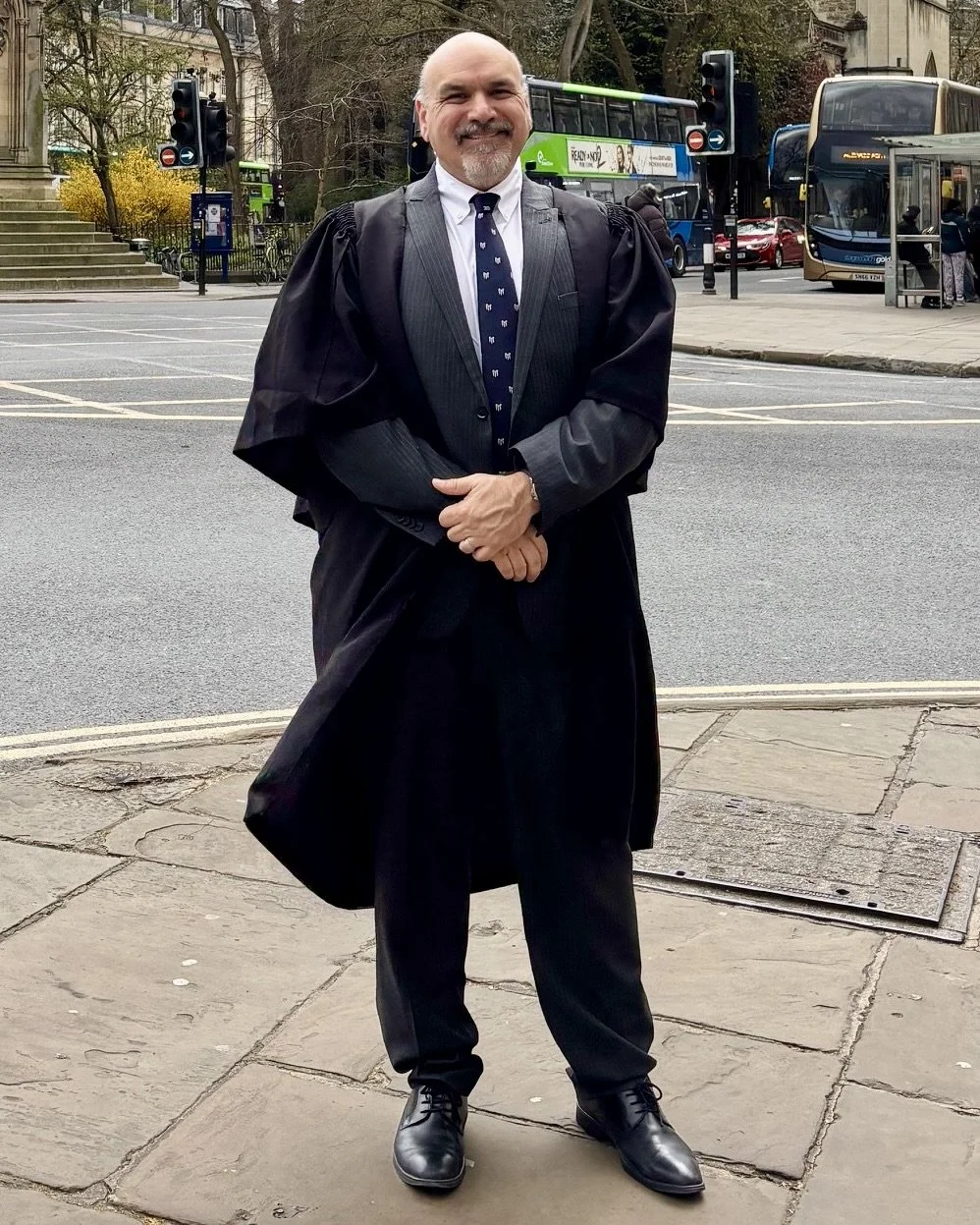
Ravi Jain at Oxford University after successfully defending his Doctor of Philosophy dissertation
We have truly remarkable news to celebrate.
Ravi Jain—a former seminary student of John Frame and Steve Childers—has successfully passed his doctoral defense at the University of Oxford and completed his Doctor of Philosophy degree (D.Phil.). In his own words:
“I write with glad tidings. On the portentous ‘Fig Monday,’ March 30, I successfully defended my dissertation… During Eastertide I have received the good news that my corrections have been accepted… I have now successfully finished my doctoral studies at Oxford. Hurray!”
His dissertation, “Whose Mathematics, Which World?”, was examined by leading Oxford scholars and received an outstanding report. One examiner wrote:
“Jain’s dissertation is a sophisticated and wide-ranging piece of work… He is at home discussing Augustine as Aristotle, Aquinas as Bertrand Russell, Dedekind as the nineteenth century divine Herman Bavinck.”
That kind of interdisciplinary mastery—spanning theology, mathematics, philosophy, and science—is rare. But what makes Ravi’s work especially important is not just its academic rigor. It is the theological vision behind it.
A Hard Calling—and a Hard Dissertation
Ravi describes his journey candidly. The days leading up to his defense were marked by exhaustion and pressure. At one point during the viva, an examiner abruptly said, “Enough with the niceties—let’s discuss my concerns.” For a moment, Ravi feared the worst.
But that tension quickly gave way to affirmation. The concerns were constructive, the corrections minimal, and the final verdict clear: he had passed with distinction.
Looking back, Ravi reflects:
“I now know the difference between an easy dissertation topic and a hard one. I chose a hard one. Nonetheless, by God’s grace, I passed.”
What made it so difficult? He was attempting something few dare to do: to bring together Trinitarian theology with the philosophy of mathematics and modern scientific thought—fields that are often isolated from one another and deeply contested within themselves.
The One and the Many—Seen Through Mathematics
At the heart of Ravi’s dissertation is one of the oldest and most profound questions in philosophy and theology: the problem of “the one and the many.” How can reality be both unified and diverse? How can there be many things, yet one coherent world?
Ravi argues that this mystery is not only philosophical—it is mathematical.
In mathematics, there are two fundamental ways of understanding quantity:
Discrete quantity: countable, separate units (like numbers)
Continuous quantity: smooth, unified wholes (like lines or space)
Historically, thinkers have tried to reduce one to the other:
Some claim the continuous can be reduced to the discrete
Others claim the discrete can be reduced to the continuous
Still others dismiss the distinction as irrelevant
Ravi takes a different path. Drawing on the work of Mary Hesse and Charles Sanders Peirce, he argues that both discrete and continuous quantities are:
Irreducible (neither can be collapsed into the other)
Mutually necessary (both are required to describe reality)
Unified in their diversity (together they form a coherent whole)
This is the key insight: reality itself reflects a unity-in-diversity that cannot be reduced to a single category.
And this, Ravi concludes, is not accidental.
A Vestige of the Trinity
Ravi connects this mathematical structure to the historic Christian doctrine of vestigia Trinitatis—the idea that creation bears “traces of the Trinity.”
He writes that we may now say “with some scholarly confidence that the mystery of ‘the one and the many’ points to the mystery of the Trinity.” Even in mathematics, he argues, “we may behold this mystery by noting the fascinating interplay of discrete and continuous quantity.”
In other words, the structure of reality itself—down to the foundations of mathematics—reflects the triune God.
This is not a simplistic analogy. It is a deeply reasoned claim: that the unity and diversity we observe in the world are grounded in the unity and diversity of God himself.
The Frame–Childers Influence: Trinitarian Perspectivalism
This is where Ravi’s work becomes especially significant for those connected to Pathway Learning.
Ravi was shaped theologically by John Frame and Steve Childers while studying with them at seminary. Their shared approach—now called Trinitarian Perspectivalism—deeply informed his theological imagination and his strong Trinitarian emphasis.
Seen through this lens, Jain’s Oxford doctoral work is not simply a philosophical or mathematical proposal. It is an outworking of a distinctly Trinitarian way of knowing (epistemology).
Frame’s perspectivalism emphasizes that reality is understood through multiple irreducible yet unified perspectives:
The normative perspective (God’s authoritative word)
The situational perspective (the facts of the world)
The existential perspective (the knowing subject)
These are not competing viewpoints, but mutually interpreting perspectives that together provide a fuller grasp of truth. Reality is not flattened into a single dimension but known through a rich, unified plurality.
Building on Frame’s triperspectivalism, Childers helped develop a fully Trinitarian vision of reality—what Frame, Childers, and Vern Poythress now call Trinitarian Perspectivalism.
At its core is this insight: the unity-in-diversity we use to understand truth reflect who God eternally is. The Father, Son, and Holy Spirit are distinct in their relationships, yet fully equal in essence. Their roles in creation, redemption, and restoration reveal these distinctions without dividing their unity.
This same triune God makes himself known in history in the good news (gospel) about who he is (his attributes) and what he does (his acts) as LORD in creation, redemption, and the restoration of all things lost in the fall of humanity.
The Father establishes God’s will in creation through his Son and by his Spirit
The Son accomplishes God’s will in redemption by the power of the Spirit
The Spirit applies God’s will by restoring the Son’s redeemed creation to its intended glory
This reflects the classic distinction:
The ontological Trinity (who God is)
The economic Trinity (what God does)
These are inseparable. As Bavinck said, “the economic Trinity is the ontological Trinity revealed”– a connection often minimized by some Classical Christian Theists today.
Childers’ key contribution is showing that this is not just theology—it is a worldview. It gives us lenses for seeing all of life. Through these Trinitarian perspectives, we learn to hold together unity and diversity across every sphere of life—faith, ministry, leadership, and even disciplines like science and mathematics.
Jain applies a similar framework to mathematics and semiotics.
What appears in mathematics as the tension between discrete and continuous quantity is, in fact, another instance of this deeper pattern:
Distinct yet irreducible realities
Mutually necessary for meaning
Unified without collapsing their differences
In this sense, Jain’s work is not merely influenced by Frame and Childers—it is a concrete demonstration of their Trinitarian Perspectival theological method applied in one of the most intellectually demanding fields in the academy.
What Frame and Childers have articulated theologically, Ravi has now explored philosophically and mathematically:
Distinction without division
Unity without reduction
Coherence grounded in a deeper, triune reality
This is perspectivalism not only as a method of knowing, but as a reflection of how reality itself is structured.
Ravi’s connection to Pathway Learning extends even further.
For many years, he and Childers have served the underground church in China together—Steve equipping church planters and pastors, and Ravi training Christian educators.
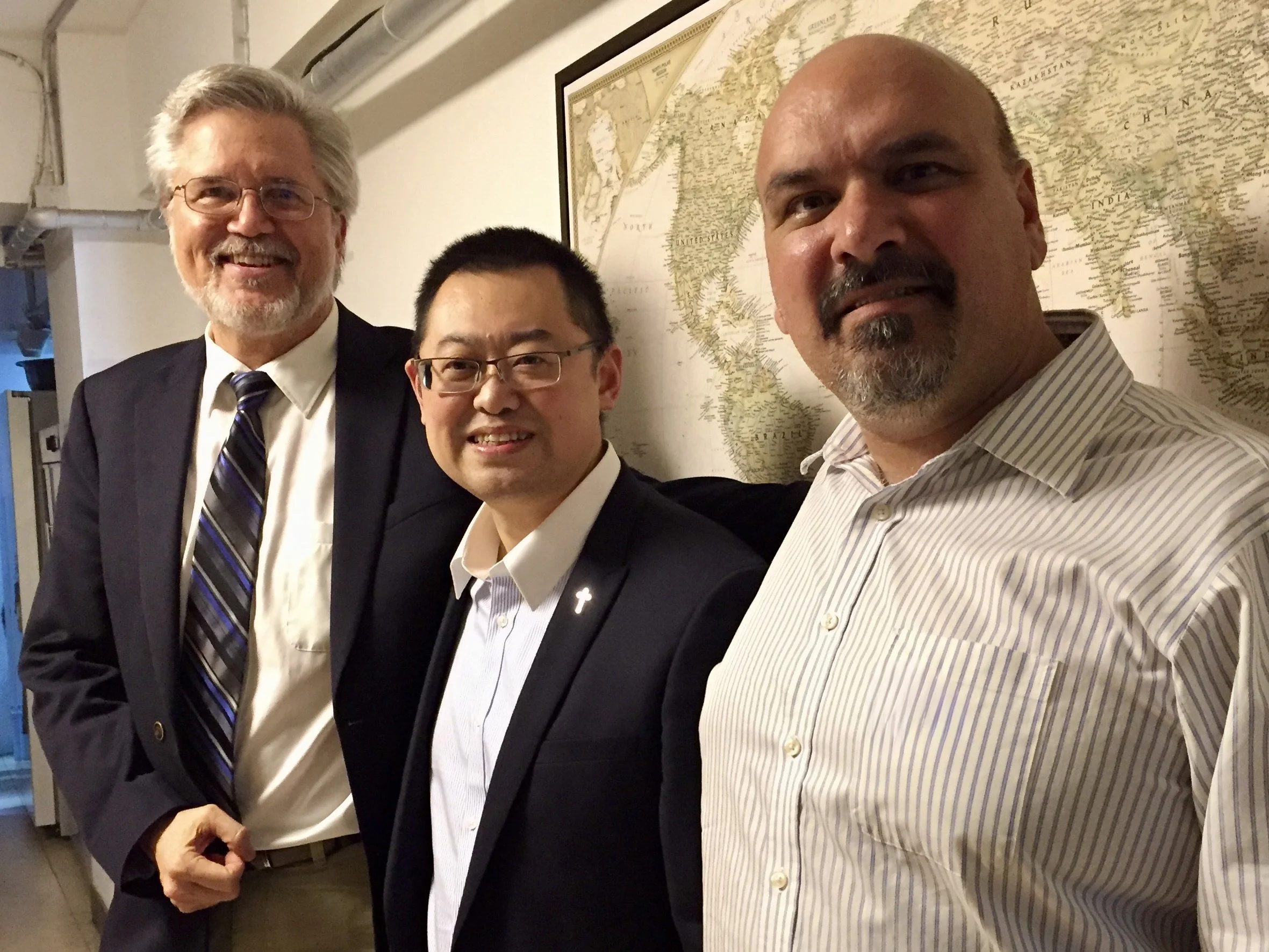
Steve Childers and Ravi Jain in China with underground church leader Wang Yi before his imprisonment. Childers was training church planters while Jain was training Christian educators
Ravi also serves as a contributing advisor and editor in the Pathway Learning Applied Theology Project Team alongside Drs. John Frame, Vern Poythress, Steve Childers, John Hughes (P&R Academic), and Steven West (Gospel Coalition). Though Ravi has necessarily taken a “sabbatical” from this in order to complete his Oxford dissertation, we expect a fruitful relationship to commence again soon in order to advance the ongoing work of developing a globally accessible, deeply integrated theological curriculum for church leaders in all the world’s major languages.
Moreover, at Oxford Ravi discovered an interesting link between his research and Frame’s thought which could inform further study. Medieval theologians spoke of the appropriations of power, wisdom, and goodness (or love) to the Father, Son, and Holy Spirit respectively. (Thomas Aquinas, Summa Theologica, 1.32.1ad1). These appropriations, sometimes associated with the traces of the Trinity, suggest a medieval analog to Frame’s triperspectival themes of control, authority, and presence.
Why This Matters for Pathway Learning
At first glance, a dissertation on mathematics and theology at Oxford might seem far removed from the mission of Pathway Learning.
It is not.
Pathway Learning exists to equip church leaders worldwide with a deeply biblical, theologically integrated understanding of life and ministry. Ravi’s work demonstrates exactly why that integration matters.
It shows that:
Theology is not isolated from other disciplines—it shapes how we understand everything
Reductionism (collapsing reality into one dimension) distorts both faith and practice
A Trinitarian framework provides a more faithful and fruitful way to engage the world
This has profound implications for global church leaders.
In many contexts, leaders are trained in fragmented ways:
Theology separated from practice
Faith separated from science
Scripture separated from everyday life
But Ravi’s work points to a better way—a deeply integrated vision of reality grounded in the Trinity.
This is the kind of vision Pathway Learning seeks to cultivate:
Knowledge (head) rooted in biblical truth
Skills (hands) applied in real ministry
Character (heart) formed in Christlikeness
All held together in a unified, Trinitarian framework.
A Glimpse of What’s Possible
Ravi’s journey is also a testimony to calling and perseverance.
“In the fretful days leading up to the defense,” he writes, “my confidence arose not so much in myself but in God and his calling… confirmed through the encouragement, prayers, and support of the body of Christ.”
This is not just an academic achievement. It is a Kingdom story.
It is what can happen when:
The church invests in theological formation.
Leaders are trained to think deeply and biblically.
Faith is applied across every sphere of life.
Bottom Line
Ravi Jain’s Oxford dissertation is more than a scholarly accomplishment. It is a powerful demonstration that the deepest structures of reality—even mathematics—reflect the unity and diversity of the triune God.
And it shows that Trinitarian perspectivalism is not merely a theological idea. It is a way of seeing the world that holds everything together.
For Pathway Learning, this is both confirmation and calling:
To continue equipping leaders everywhere to see all of life—faith, ministry, knowledge, and the world itself—through the lens of the Trinity.
ATTN: Don’t miss our newest Pathway Learning book in the Faith, Hope, and Love Trilogy by Childers and Frame: Click here
