

LEARN
Article Resources
Core Convictions: Christ-Centered Preaching Series 1 of 6
By Larry Kirk
In 2 Timothy 4:1–2, Paul gives Timothy one of the most solemn and weighty charges in all of Scripture:
“In the presence of God and of Christ Jesus, who will judge the living and the dead, and in view of his appearing and his kingdom, I give you this charge: preach the word. Be prepared in season and out of season. Correct, rebuke and encourage—with great patience and careful instruction.”
This is only one of many passages in Scripture that speak about preaching. But it captures something essential: preaching is not a peripheral task in pastoral ministry. It is central.
There are many good and important things that pastors do. We plan services. We shape liturgies. We develop small groups. We build discipleship strategies. We think about leadership development, evangelism, and mission. All of these matter.
But when you read the New Testament, nothing is emphasized quite like this: preach the word.
For example, almost every church I know today is deeply committed to small groups—and for good reason. They serve fellowship, community, discipleship, and mission. But nowhere in the New Testament do you find a command that says, “Develop small groups.” You do, however, find repeated, explicit, emphatic commands to preach.
I once searched the New Testament for the words “preach” and “preaching.” I found nearly 100 passages, 79 of them in the New Testament alone.
In Matthew’s Gospel, as soon as Jesus emerges from the birth narratives, we read, “From that time Jesus began to preach.” Later, “He went from town to town to preach.” Jesus describes his own ministry by saying, “The poor have the gospel preached to them.” He reminds his hearers that Nineveh repented at the preaching of Jonah—and then uses that to indict his own generation for not repenting at his preaching.
In Mark’s Gospel, the word “preaching” appears four times in the first chapter alone. Jesus says, “I must go to other towns also, to preach there.” He appoints the twelve and sends them out to preach. They go and preach everywhere.
The same pattern continues throughout Acts and the Epistles. Peter preaches. Paul and Barnabas preach. Paul asks for prayer that he might preach boldly. And when Paul writes to Timothy and Titus, he tells them—again and again—to preach.
It is so common in Scripture that we almost stop seeing it.
Preaching and the Renewal of the Church
What Scripture emphasizes, history and research confirm.
Dr. Thom Rainer conducted a major study of churches that had declined or plateaued and then experienced genuine renewal. In every case, one of the dominant factors—often the dominant factor—was the preaching of the senior pastor. Not merely that he was a “good communicator,” but that his preaching was shaping and leading the renewal.
Rainer also studied church plants and found something similar. When people were asked what most influenced them to come, stay, and commit, the most common answer was the preaching.
Christianity Today once did a large study asking why people with a church background, who moved to a new community, chose the church they did. The number one answer was the beliefs of the church (89%). The second was the preaching of the senior pastor (87%). Worship style, children’s ministry, and other factors all ranked lower.
Mark Dever famously writes that the first and most important mark of a healthy church is expositional preaching, because if you get this right, all the others should follow.
There are complexities in how that plays out in real life, of course. You can preach excellent sermons on evangelism and still not instantly produce a congregation full of bold evangelists. But the basic insight is sound: preaching is one of the primary ways God shapes, guides, and renews his church.
So the question becomes: How can pastors and church planters preach in a way that truly changes lives—both believers and unbelievers—for the glory of God?
The Foundation: Core Convictions
Here is the first main principle:
Lay a foundation of core convictions for gospel-centered preaching.
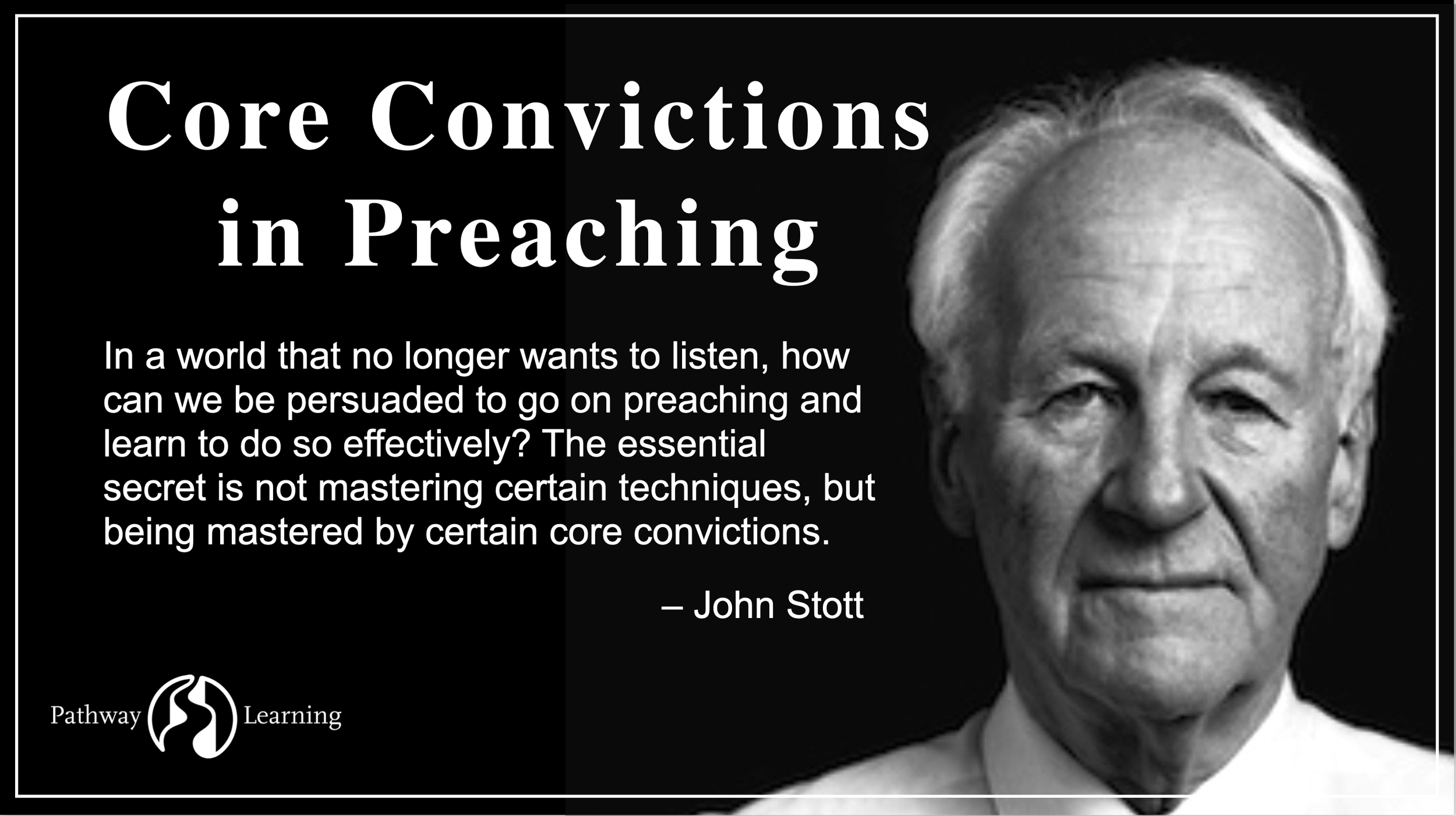
John Stott puts it memorably:
“In a world that no longer wants to listen, how can we be persuaded to go on preaching and learn to do so effectively? The essential secret is not mastering certain techniques, but being mastered by certain core convictions.”
If you are truly convinced that you must preach the word—that your preaching must expose what is actually in Scripture—you will find a way to do it, even if your techniques are imperfect.
If you are convinced that people must clearly understand the implications of God’s word for their lives, you will labor to make your message plain, even if your illustrations are not brilliant.
If you are convinced that preaching is a God-ordained means of grace through which God changes hearts, you will keep preaching “in season and out of season,” even when you feel inadequate or discouraged.
Techniques matter. But convictions drive everything.
So what are some of these core convictions?
1. Dependence on the Holy Spirit
Authentic preaching is always a test of faith.
On our best days, we stand before a congregation made up of real people with real crises: broken marriages, secret sins, deep grief, fragile faith, and desperate need for grace. We bring what we have prepared—and it feels like the boy with the loaves and fishes. What we bring is never enough.
Yes, God is sovereign. But he works through human instruments. And unless God himself works, nothing truly lasting will happen.
The greatest preachers in history—men like Charles Spurgeon—spoke often and openly about their dependence on the Holy Spirit.
The image is like Elijah on Mount Carmel. He builds the altar. He arranges the sacrifice. He even pours water on it. Then he steps back. Unless God sends fire from heaven, nothing happens.
This conviction must shape not only how we preach, but how we prepare and how we pray. For me, this means cultivating dependence all through the week—and especially in worship before preaching. However you structure your own disciplines, you must learn to step into the pulpit consciously dependent on the Spirit of God.
2. Love for the People You Preach To
Another core conviction is genuine love for those you serve.
Jack Miller, in Outgrowing the Ingrown Church, describes “preaching by faith.” He used to sit on the platform before preaching and look out over the congregation, deliberately reminding himself of God’s deep love for each person.
Preaching is not delivering information to an audience. It is loving real people with the truth of God.
If you truly love them, you will labor to be clear. You will speak with patience. You will apply the word with both courage and tenderness.
3. Faith in the Power of God’s Word
There are many voices today saying that preaching is not very effective, that what really matters is one-on-one discipleship or small groups or personal counseling.
All of those are important. But Scripture shows us again and again that God uses the public preaching of his word to save, convict, and transform.
Jesus preached. Peter preached. Paul preached. And the Holy Spirit worked.
Some of the great movements of revival in history can be traced back to a single sermon that God used to change a life—who then changed other lives, and so on.
We should step into the pulpit with real faith that God works through his word.
4. Humility and Hard Work
Another essential conviction is humility.
Preaching is never about displaying ourselves. It is about serving Christ and his people.
And humility always shows itself in a willingness to work hard. Paul speaks often about laboring. Preaching well—especially in today’s culture—requires serious study, serious thought, serious prayer, and serious preparation.
5. Proclaiming Christ in All Things
At the center of everything is this final conviction: in all our preaching, we proclaim Christ.
Paul writes in Colossians 1:28:
“We proclaim him, admonishing and teaching everyone with all wisdom, so that we may present everyone mature in Christ.”
Whether we are teaching, correcting, or encouraging, the ultimate goal is always the same: to bring people to maturity in Christ.
Not to showcase our insights. Not to impress with our skill. Not to build our own reputation.
We proclaim him.
Conclusion
In a world that no longer wants to listen, the future of faithful preaching will not be secured by better techniques alone.
It will be secured by men who are mastered by deep, biblical, Christ-centered convictions—and who step into the pulpit week after week in dependence on the Spirit, love for their people, faith in God’s word, humility, and a relentless commitment to proclaim Christ.